Monterey set a $758M record. The 1950s and 1960s were the only decades below guide.
The 2026 Monterey auctions came in at a record $758.3 million, up from $432.8 million a year earlier. Sell-through held at 76 percent, and the average sale price rose from $529,034 to $887,948 (Hagerty). On its own that reads as a market running hot.
Then there is the other number from the same report. Cars from the 1980s through the 2020s sold at median premiums of 31 to 38 percent over Hagerty's condition-appropriate guide values. Cars from the 1960s, with the Cobra Daytona Coupe excluded, sold at a median 6.2 percent below guide. The 1950s were negative too. Those were the only two decades in the red, and they made up more than a third of the lots on offer.
A record total and a negative median in the same week are not a contradiction. They are the same fact seen from two directions. The money did not get bigger so much as it moved.
Who is holding the paddle
I work on identity and pricing data for alternative assets, so my instinct is to look at the buyer pool before the asset. Collecting has never been a spreadsheet exercise. People pay irrational money for objects that remind them of who they were and what they wanted before they could afford any of it.
For one generation the poster on the wall was a Jaguar E-Type, a 300SL, a Ferrari 250. For the generation that came up twenty or thirty years later it was an F40, a Countach, a 959, a Skyline GT-R, an NSX. Later a Carrera GT, a Murciélago, a Ford GT.
That second group is now in its peak earning years, and the results read like a list of their bedroom walls. Records fell for the F40 at $8.365 million, the F50 at $14.575 million, the 288 GTO at $11.555 million, the Countach LP400S at $2.4 million, the Murciélago LP640 at $3.1 million. Hagerty put modern supercars at more than half of all sales.
Meanwhile a 1955 300SL Gullwing, arguably the most recognizable postwar car ever built, finished tenth in its own auction house's results at $2,975,000, below what a Diablo GT and a Countach were bringing elsewhere in the week.
This is not the postwar market collapsing. It is a changing of the guard, and the guard being changed is the marginal bidder. The last two people willing to raise a paddle set the price, and those two people now formed their taste after 1980.
Two caveats worth saying out loud
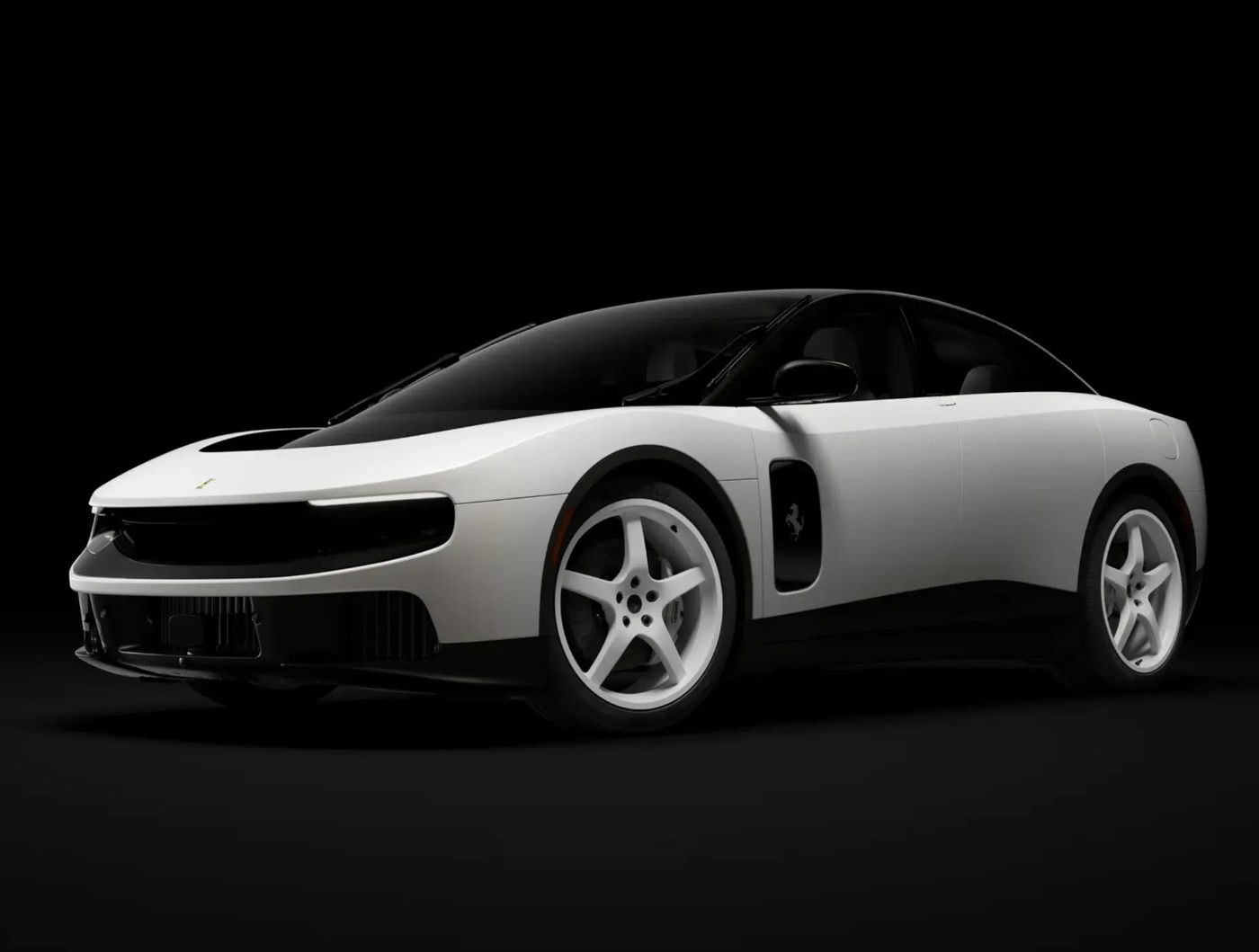
The 2026 Ferrari Luce Tailor Made. Forty million dollars, and it is a four-door.
The headline number deserves a second look. That car above was the second-highest sale of the week, and it was a charity lot with proceeds going to the Ferrari Foundation. Strip it out and the week comes to $718.3 million (Magneto). Still a record against 2022's $471.2 million, but a charity sale is not a market price and should not be treated as a comparable.
The second caveat is smaller and it bothers me more. There is no single agreed total for the week. Hagerty reported $758.3 million. CLASSIC.COM counted 850 cars for $751 million at an average of $892,317 (CLASSIC.COM). Road & Track put it near $762 million including premiums and charity (Road & Track). That is roughly $11 million of spread on a definitional question about what counts as a sale. Anyone building an index on top of a single published figure has inherited that ambiguity without disclosing it.
What actually gets lost
I understand why the modern cars are appreciating, and I like a lot of them. But some things get harder to reproduce as cars get newer, and they are not the things that show up in a performance comparison.
A thin wooden wheel bolted to a car with no interest in insulating you from what is happening underneath it. Switchgear that has weight to it. An engine with a temperament you have to learn instead of a menu you have to scroll. Bodywork shaped by someone's hands rather than optimized entirely in software. The smell of leather and warm oil in a closed garage.
And provenance, which is the part that cannot be manufactured at any price. An old car has already lived a life before you get it. It crossed a continent, passed through four families, sat in a barn for thirty years, raced somewhere badly, got put back together by a man who spent a decade finding the correct carburetor. Or it simply survived a period when nobody believed it would ever be worth anything, which is its own kind of achievement.
I wrote something a while back that I keep coming back to:
The older I get, the more I appreciate things made with craftsmanship, history and soul: vinyl through great speakers, fine art, rare first editions, manual vintage cars, mechanical watches, tea from beautiful china, and traditional homes warmed by real wood fireplaces. I hope progress never costs us our appreciation for the things worth preserving.
Cars are the clearest case of it. A modern supercar is faster, safer, more reliable and more technologically remarkable than anything built in 1962, and it can be better in every measurable category and still leave me wanting the older car. Technical superiority and emotional superiority are different axes. The market only prices one of them.
The market does not need my agreement
None of that is an argument about value. If the people entering the hobby grew up dreaming about cars built between 1985 and 2005, capital will keep going there, and the divergence we just watched is the early evidence.
What it means practically is that lumping all of this together under "collector cars" is becoming misleading. There are two markets now. One runs on history, rarity and established collecting convention. The other runs on the nostalgia of a younger cohort whose reference points start decades later. They are moving in opposite directions against the same guide values, which is the clearest signal you can get that they are not one series. If the negative median for the 1950s and 1960s holds across another couple of major sales, that stops being an auction-week artifact and becomes a structural split that has to be measured separately.
There is an upside in that for anyone who actually likes the old cars. They get more attainable. Some genuinely extraordinary machinery from the 1950s, 1960s and 1970s may become buyable at numbers that looked impossible during the last boom.
It does create an honest dilemma, though. Buying into an aging buyer base is not the same trade as buying into a growing one. The better investment and the better object may no longer be the same car, and I think you have to be willing to say which one you are actually choosing.
Not everything worth owning has to beat the S&P. Something beautifully made, historically important and increasingly uncommon carries a return that never lands on a performance chart. Sometimes preservation is the return.
What probably happens next
I do not think traditional classics go away. The great examples stay great. A historically significant Ferrari, Bugatti, Mercedes or Shelby does not become irrelevant because a younger generation prefers something else, and the $42.9 million Cobra Daytona Coupe was the top sale of the entire week.
The middle is where it changes. Cars that were automatically desirable because they were old will stop getting that benefit. Younger buyers are more selective and age alone will not carry a car. At the same time, things that were merely used exotics twenty years ago are being handled as historical artifacts. The Diablo is not just an old Lamborghini now. The F40 is not simply a fast car. They are becoming the cultural objects of a different generation, which is probably how this has always worked. Every generation decides which pieces of its own youth are worth keeping.
Markets move, taste moves, generations turn over. Craftsmanship and provenance do not become less meaningful because they became less fashionable. If anything, a softer market for the old cars is an opening for the people who actually care about them to become the next custodians.
The return might be worse. I can live with that. If the choice is owning what the market says I should want, or owning something that makes me stop and look back at it every time I walk away, I will take the car with the story.