I Was One of the People Who Thought the Electric Boxster Was a Mistake
Porsche was out testing the new 718 at the Nürburgring last week and somebody finally got pictures of it without camouflage on. It comes after Porsche's new CEO, Michael Leiters, shut down the rumors that the car had been cancelled. He said in August that they would build it because it's the best solution economically and it will be a fantastic car.
When the electric 718 was first announced I went through the comments on LinkedIn, and most of them were a version of the same thing. Why bring back a car that didn't sell. I agreed with them. I had the Boxster filed in my head as a car Porsche built for a while, sold in modest numbers, and eventually let go of.
That's wrong, and it isn't close.
The Boxster is the reason Porsche still exists
In 1986 Porsche sold more than 30,000 cars in the US and Canada. By 1993 that number was 3,700. The company was losing hundreds of millions and there were serious conversations about whether it could survive on its own.
The Boxster reached production in 1996. At the end of that year Porsche reported its first profit in four years. By 2004 they had sold 146,874 of them worldwide.
Most people tell this story with the Cayenne as the hero, and the Cayenne is what made Porsche rich. The Boxster is what kept the company alive long enough to build the Cayenne.
The 718 wasn't limping at the end, either. In 2024, its last full year of production, sales went up 15 percent to 23,670 cars. The 18,612 figure for 2025 is low because production stopped in October. That's a car that was retired on purpose, not one that got dropped for lack of buyers.
They got written off with the Taycan too
I remember how the Taycan news landed. In January 2020 the EPA rated the Taycan Turbo at 201 miles of range and 69 MPGe combined. That was the lowest efficiency figure of any electric passenger car rated for sale in the US at the time. It was worse than the Audi e-tron and the Jaguar I-Pace. Porsche had been teasing 300 miles, and the Model S Long Range was sitting at 373.
The conclusion everybody drew was that Porsche could build a fast electric car but didn't really understand electric cars. I was working at Tesla at the time and that number got talked about a lot.
Then people started driving them.
Car and Driver ran a base Taycan through their 75 mph highway test in 2021 and got 280 miles and 97 MPGe out of a car the EPA said would do 225. The 2025 updates took the rear drive car from 280 to 360 miles in that same test. Edmunds got 364 out of one with the bigger battery. InsideEVs got 367 out of a car rated at 318.
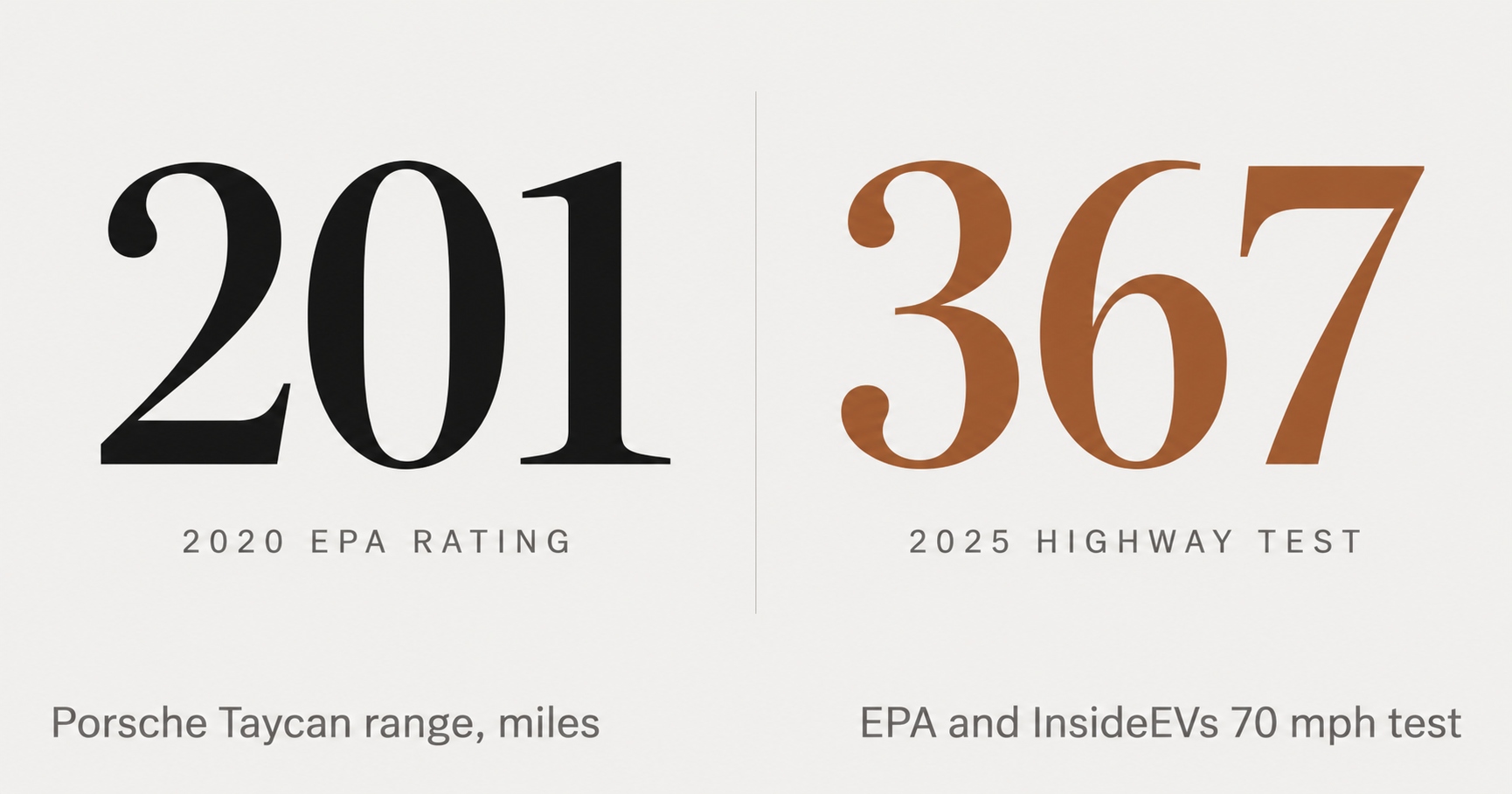
The number that got the Taycan written off, next to what the car actually does.
The EPA number was never a very good reflection of how the Taycan performed on the highway. Porsche just certified it more conservatively than everyone else did.
The Cayenne test
My friend Kyle Conner runs Out of Spec Studios. We worked at Tesla together in the early years, around 2016 and 2017, and he has since built the most demanding independent EV testing setup I know of. The last time I saw him in person was at CES in 2025, when we launched the Gravity and he was one of the first people I walked through the car.
One of his tests is the 10% challenge. Start at 10 percent battery, fast charge for exactly 15 minutes, then drive 80 miles an hour until you're back down to 10 percent. The point is to measure what a road trip actually feels like instead of what a lab says.
He ran the new Cayenne Electric through it in North Carolina in 91-degree heat. It took on 80 kWh in those 15 minutes, averaging 320 kW, and then covered 186 miles at a constant 80 mph. That works out to 2.60 miles per kWh.
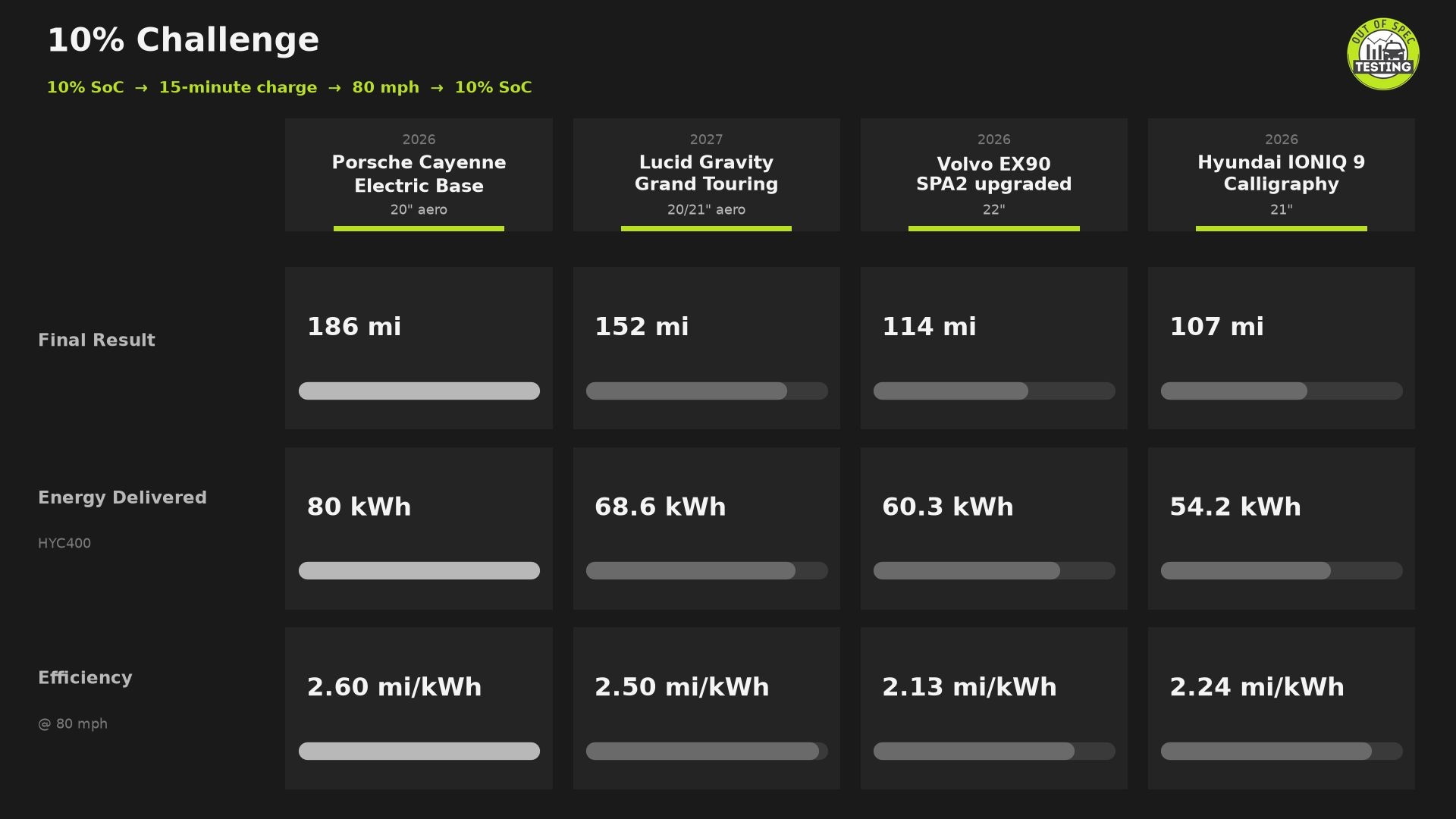
Results card from Out of Spec Studios. Same protocol, same charger, four vehicles.
For a 5,000-pound SUV holding 80 miles an hour in that kind of heat, those numbers are hard to believe. The Lucid Gravity Grand Touring did 152 miles. The Volvo EX90 did 114. The Hyundai Ioniq 9 did 107. I worked at Lucid, and the Gravity is the most efficient SUV I've ever been in. I've worked in and around EVs for more than a decade, so watching a Porsche SUV put 34 miles on it says something about where Porsche has landed.
The all-time record on that test still belongs to the Taycan sedan at 193 miles, set at around 45 degrees and at altitude in Colorado. The Cayenne came seven miles short of that with its cooling system working flat out at 91 degrees at sea level, and Kyle's read was that on a comparable day it would match or beat the Taycan. The top two results on that leaderboard both belong to Porsche.
None of this came at the expense of the old cars
This is the part I didn't expect, and it's the reason I've stopped worrying.
The manual 911 Carrera S came back for North America this year, announced at Monterey. Six speeds, rear-wheel drive, coupe or cabriolet. Porsche's North America boss, Timo Resch, said the manual gearbox stays as long as it's legal and customers want it. The Carrera T still has three pedals. The Cayenne and Panamera still offer V8s. The 911 GTS went hybrid in 2025 and it turned out well.
I'm a manual 911 person. That's the car I want and that's the car I'd buy. So when a company starts building electric versions of everything, my instinct is to assume the car I like is quietly on its way out the door.
Porsche hasn't given me any reason to think that. They keep the manual, they keep the V8, and they go set the road trip benchmark on the electric side in the same year.
What's still unknown
Three times now the pattern has been the same. An early number looks bad or a decision looks strange, the comment section calls it a failure, and the car turns out fine. The original Boxster, the Taycan, and now the Cayenne all went through some version of that.
What nobody can answer yet is whether enough people will buy a small electric two-seater. That's a hard segment with any kind of engine, and the 718 has always been the car people bought when they couldn't quite get to a 911. An electric one is going to ask for real money in exchange for two seats and not much room for anything else. Leiters says the economics work, and he has better information than the rest of us do.
Whether it sells is still an open question, and nothing in the Taycan or Cayenne results answers it. But I'd like to drive it, which is more than I would have said about it a year ago.