I've Always Wanted a Range Rover. The Electric One Doesn't Fix the Reason I Never Bought One.
I've wanted a Range Rover since I was about sixteen. Not a particular one, just the shape, which has barely changed in fifty years, and the way it sits above everything around it without looking like it's trying to. Put a 1970 model next to the one that went on sale today and you can see they're the same idea. That kind of continuity is rare and I've always liked that it came out of a country that builds something, gets it right, and then mostly leaves it alone.
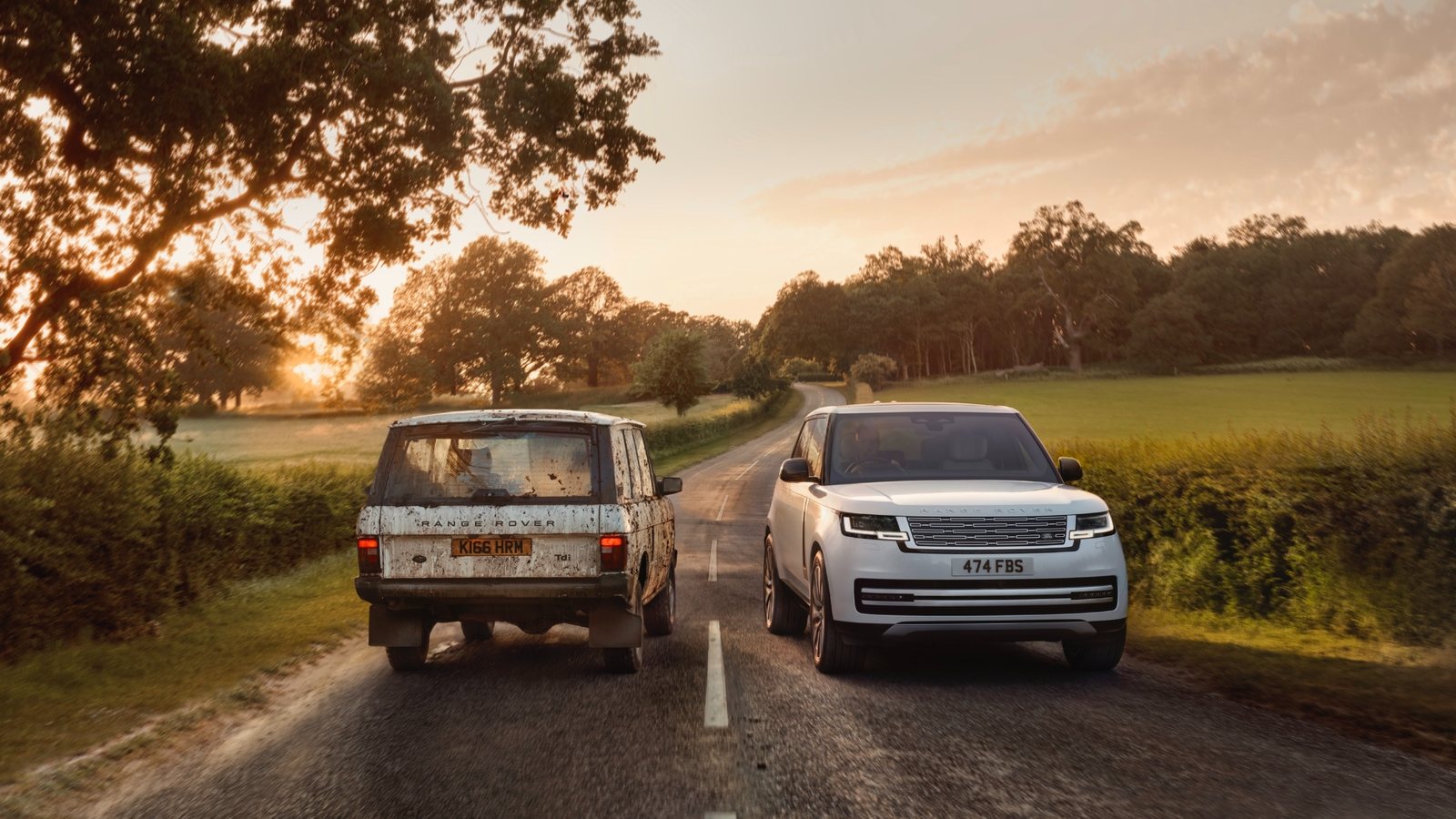
From the launch photography. The muddy one is a Range Rover Classic, the shape that ran from 1970 to 1996.
I've never bought one, and there are two reasons rather than one.
The first is the money. The electric version starts at $140,550 here, which is about twenty five thousand more than the gas car, and almost nobody buys one of these at base. Option it the way people actually order them and you're past $170,000. I've talked myself out of that number more than once, and every time it was the same arithmetic: that's a down payment on a house sitting in a driveway losing value.
The second reason is the one anybody who has shopped for one already knows. These cars have a reputation for breaking, and the repairs aren't small.
Either problem on its own I could probably get past. A cheap car that spends time in the shop is irritating but survivable. An expensive car that never breaks is a stretch you make once and then stop thinking about. It's the two together that have stopped me every time I got close, because a bad month arrives on top of a payment that was already the biggest one in the house.
So when JLR opened orders today on the electric version, the thing I actually wanted to know was whether electrification fixes the second problem. If it does, the first one turns back into a normal decision about money. It's being built at Solihull on the same line as the combustion cars, with the battery packs and drive units coming out of Wolverhampton.
The argument that comes attached to every electric launch is that there's less to go wrong. There are no spark plugs, no timing chain, no oil changes, and fewer parts turning against each other. On this car that argument should count for more than it does anywhere else, because reliability is the whole objection. So I went looking for what actually breaks on a Range Rover.
The Engine Is Only a Third of It
The most detailed public breakdown I could find comes from warranty claims. For the full-size Range Rover, engine faults are 27.75% of claims at an average of about $4,200 each, suspension is 26.75% at roughly $670, and electrical is 18% at roughly $630. It's claims data from a warranty company, so it skews toward cars out of factory cover and toward owners who bought a policy, but it's a lot more specific than a star rating.
Read those three numbers again with electrification in mind. The engine slice is the expensive one, and it's the only one that goes away. Suspension and electrical add up to 44.75% of claims and neither of them cares what's turning the wheels.
The pattern holds across the range. What Car? puts electrical and electronic faults in the top three categories for every Land Rover model they survey. On the Defender 110, electrical is 41% of claims all by itself. The brand ranks 26th out of 30 in their most recent survey and 27th of 31 in J.D. Power's dependability study, and Consumer Reports can't rank Land Rover at all because they don't get enough responses, though they still put it in their bottom five.
Air Suspension Doesn't Care What's Driving the Wheels
The electric Range Rover keeps the twin-chamber air suspension, which is the right call. It's most of what makes the car feel the way it does, and it's how you get 35 inches of wading depth. But it's also a system that fails, and typical repairs run somewhere between $540 and $1,600.
The electric one weighs 6,360 pounds. That's heavier than the plug-in hybrid, and it's the same air springs holding it up.
Towing capacity went the other direction. The combustion Range Rover is rated at 7,700 pounds and the electric one at 5,500. That's 2,200 pounds of a capability people actually buy this car for, and it's the kind of specification that doesn't show up in a launch video.
The Parts Count Argument Leaves Things Out
The line you see everywhere is that an electric drivetrain has around twenty moving parts against two thousand in a combustion one. I used that comparison plenty of times when I was at Tesla and I believed it. It traces back to manufacturer marketing rather than to any independent teardown.
The engineer David Twohig went through it in detail and pointed out what the comparison skips: high voltage cabling, inverters, DC to DC converters, onboard chargers, high voltage junction boxes, and the fact that the car now runs two separate electrical systems at once. His conclusion was that total part counts come out fairly comparable.
That list isn't theoretical. In April of this year JLR recalled current Range Rovers over a propulsion DC to DC converter. It's a component that only exists because the car is electrified, and it's sitting right there on the list of things the parts count claim doesn't count.
What Car? states the general version of this outright. Their words: the most common faults with electric models are not related to their electric motors or EV battery packs. They're 12V batteries, infotainment, and the same electrical annoyances the petrol versions have. J.D. Power has software at 9% of all reported problems, and phone connectivity is the single largest problem in the entire industry at 8.4 problems per hundred vehicles, getting worse rather than better.
That lines up with what I saw. I spent eight years at Tesla, a lot of it running service and delivery, and the work coming through the door was 12V batteries and screens far more than motors or battery packs. In a Las Vegas summer the 12V failures came in waves. Hardly any of it was the part of the car that was actually new.
So electrification takes out the engine, which is a real and expensive category, and hands the car more of the thing that was already going wrong.
They've Only Sold One EV Before, and Somebody Else Built It
This is the part that gave me pause.
JLR has shipped exactly one electric car, the Jaguar I-Pace. In the What Car? survey it scores 86.0%, the worst result of any Jaguar, and the specific note attached to it is a high incidence of battery pack and motor problems.
Magna Steyr built the I-Pace under contract in Austria. JLR designed it and someone else assembled it. This new one is different. The motors and the packs are in-house at Wolverhampton and JLR is building the car itself, on a mixed line that also produces mild hybrids, plug-in hybrids and pure combustion versions of the same vehicle. They say they've put 10,500 workers through training for it.
I don't think a bad I-Pace score predicts a bad Range Rover Electric. But it means there's no track record here to reason from, on a vehicle where the company's reputation for this exact category of fault is already the thing everyone brings up first.
The recent precedents in this segment aren't reassuring either. Volvo delayed the EX90 by more than two years over software and then shipped it missing CarPlay, its lidar safety system and two intersection safety features, with no timeline for when they'd arrive. Lucid's interim CEO said the Gravity's software wasn't ready for production and that he'd replaced the entire software leadership team. Both of those companies had better software records going in than JLR does.
The Timing Is Rough
It's worth knowing what state the company is in while it does this.
JLR's fiscal 2026 pre-tax profit was about $19 million. The year before it was roughly $3.4 billion. Free cash flow was negative $3 billion. A cyberattack stopped production for five weeks starting last September, and one estimate puts the cost around $2.6 billion, calling it the most financially damaging cyber incident in British history. They cut up to 500 UK management jobs last July and up to 300 more this July.
The 2021 plan promised six electric Land Rovers within five years. The June investor day reframed that around what they now call propulsion flexibility, and added a full hybrid to the first Range Rover on the new electric platform. The battery plant in Somerset has moved to late 2027.
None of that tells you whether the car is good. It does tell you the software and quality organization behind it is being asked to do its hardest launch in a decade while the business absorbs the worst year it's had.
Where That Leaves Me
I'm going to wait, and the price is part of that. At $170,000 optioned, a car has to be something I feel certain about, and I'm not there.
The 372 mile WLTP figure will come down in real use, the way they all do, and Autocar already expects highway driving to land closer to 250. That's fine. The 800 volt architecture, the 350kW charging, the heat pump that claws back 25 miles in the cold, none of that worries me. The engineering that's genuinely new here looks like it was done carefully.
What bothers me is that the systems that made me nervous about this car are all still in it, and they're doing more work now than they were before. The suspension is holding up more weight, the electrical architecture has grown, and the software has more to manage and more ways to get it wrong. Electrification takes the engine off the table, and the engine was about a third of the problem.
Ask me again in three years when there's warranty data on it.
If you own a current Range Rover, I'd genuinely like to know what's actually been in for repair and what it cost. That's the number I can't find anywhere, and it's the one that would change my mind.