The Auto Industry Isn't Making One Bet on Robots. It's Making Three.
Hyundai's CEO said this week that the company could sell robots through its dealer partners, and that Hyundai Capital is working out how you'd finance one. Stella Li at BYD said something similar back in June, that automakers have a natural advantage here.
Both got written up the same way, as more proof that carmakers are moving into robotics.
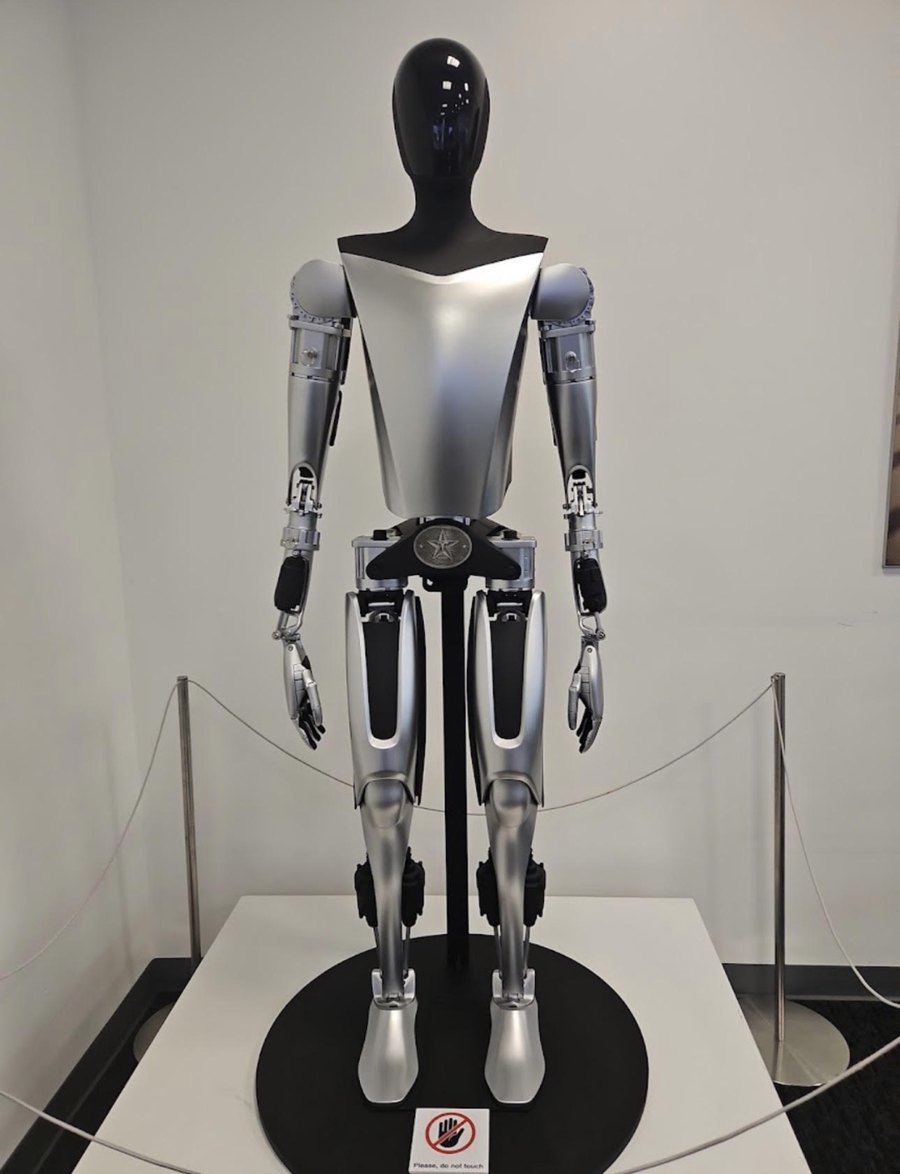
Optimus on display. Stationary, roped off, and still without a published price.
I've been reading these announcements for a few months now, and I don't think they're telling one story. There are three distinct things happening underneath them, each requires a different set of strengths to pull off, and only one has anything to do with a dealer.
Three Robot Bets, Three Very Different Businesses
The first is what nearly everybody is doing, and it's the least interesting: putting robots to work inside their own factories. BMW ran Figure 02 at Spartanburg long enough to move more than 90,000 components. Toyota has Agility's Digit units working at its RAV4 plant in Canada. Hyundai has committed to deploying more than 25,000 Atlas units across its own facilities, though that rollout is being held up by its union pending a labor agreement.
Notice what that bet actually requires. It's not being good at robotics, because none of them are. It's being good at manufacturing engineering, which all of them already are. In this case, they're buyers, and buying is the easy part.
The second bet is selling robots to somebody else, and that's where the dealer discussion comes in. The list of companies actually doing it is still short and mostly Chinese. Chery will sell you a Mornine for about $41,400 through a subsidiary, while Xpeng has a few hundred IRON units in factory trials and plans to build a thousand a month. The number I'd focus on, though, is Faraday Future. By the end of April, it had shipped just 68 units against a full-year target of 1,500. That gap is probably the clearest picture of where this bet really stands.
The third bet is already happening, and it's the one people tend to forget. A car that drives itself is a robot that happens to carry passengers. Barclays puts the global robotics market at nearly $1 trillion by 2035, with autonomous vehicles leading the way, ahead of drones and well ahead of humanoids. So the version of this that's furthest along is the one carmakers were already building before anyone started talking about humanoid robots.
The Dealer Advantage Is Real, but Only for One of Them
Selling someone a robot means taking the order, delivering a heavy and fragile machine, stocking parts, and sending a trained technician when it stops working. That makes it a service business with a product attached, and service is probably the least glamorous thing a car company owns.
It's also close to impossible to build from scratch, which is why the argument is so compelling. There are roughly 16,990 franchised light-vehicle dealers in the United States, and no robotics company has anything remotely comparable. You can't raise your way there quickly, either, because much of the value comes from technicians trained years ago and facilities that already exist. Someone is already testing the idea, too. A dealer group in China that operates Mercedes and Hyundai stores has been cleared to sell UBTECH humanoids, including delivery and maintenance.
Then there's the word "franchised," which is doing more work in that sentence than it seems. Those stores are independent businesses. Mercedes-Benz USA has more than 350 dealers in this country and owns exactly one of them.
So what a carmaker has isn't a network it controls. It's a few hundred contracts with independent owners who make their own decisions. Convincing them to carry inventory, buy tooling, and train technicians for a product with no repair history and no established resale value means having that conversation hundreds of times. And before any of them say yes, they're going to want to know who eats the warranty. I don't know the answer, and I haven't seen anyone ask the question.
Robotics Has a Long History of Big Promises
Honda spent 18 years developing ASIMO and shut the program down in 2018 without ever selling one. Ford and Volkswagen closed Argo AI and took a $2.7 billion charge. GM pulled funding from Cruise and said doing so would save more than $1 billion a year.
What's more telling is that the skepticism is no longer coming from the outside. GM has passed on humanoids, with its product chief saying plainly that it's not clear legs are the right answer. BMW's own logistics executive says the robots are still slower than people. And Musk admitted in January that no Optimus robot was doing useful work at Tesla, which is an unusual thing to say about a program you're rebuilding a factory around.
The Most Important Number Is the One Nobody Publishes
Prices are easy to find. Unitree will sell you a humanoid for $13,500 at the low end or roughly $100,000 at the top. Bank of America puts today's pilot units at around $90,000 to $100,000, with costs potentially falling below $17,000 by 2030.
What I can't find anywhere is what it costs to keep one running for a year. How often it fails. Whether the replacement part is sitting on a shelf or six weeks away, and how long the machine stays down while you wait for it. How much training a technician needs before they can work on one. And what percentage of units are still operating twelve months after installation.
I spent a long time on the physical side of this business, first with electric vehicles and then with autonomous ones, and one thing kept proving true: changing the drivetrain or removing the driver doesn't change how much of the work happens after delivery. Every one of these machines gets delivered, breaks, needs a part, and eventually needs someone to show up and fix it. That was true of a Model S, and it'll be true of a humanoid. Until someone publishes a credible annual cost of ownership, it's hard to know whether this is a real business or just a very expensive demonstration.
The demonstrations are getting bigger either way. Humanoid shipments grew nearly 300 percent in the first half of this year, to more than 22,000 units. More than 60 percent of those went to entertainment, demonstrations, and training-data collection rather than actual work.
The Car Business Isn't Going Away in Order to Pay for This
I went into this assuming I'd find carmakers quietly pulling back from passenger vehicles to fund all of this. They aren't. Toyota just produced a record 11.3 million vehicles, while Ford posted record revenue with no robotics line in its 2026 spending plan at all. Whatever is happening here is being added on top of the car business, not funded by taking away from it.
One company is taking the opposite approach. Tesla is ending production of the Model S and X to make room for Optimus at Fremont, against a capital spending plan of more than $25 billion.
Which leaves me with a question I can't answer. If a car that drives itself is a robot, the factory is increasingly run by robots, and some of these companies eventually want to sell robots through the same stores that sell cars, then at some point the passenger car starts to look like one product line inside a broader machine business rather than the business itself.
Maybe that's where this goes. What stands out to me is that almost everyone running these companies is hedging instead of choosing one path, and they know a lot more about where this is headed than I do.